What Is Medical Injection Molding?
Medical injection molding is a specialized process used to create complex plastic parts for healthcare applications under tightly controlled and validated conditions. The core objective is to deliver parts that meet strict requirements for dimensional accuracy, material purity, mechanical strength, and patient safety. The process relies on dedicated molding presses, optimized tooling, automated handling, and rigorous monitoring of temperature, pressure, and cycle parameters.
What separates it from standard manufacturing is its emphasis on full traceability, documentation, and compliance. Every batch of components must conform to regulatory expectations, undergo quality inspection, and align with documented validation protocols. This level of control ensures that components used in surgical devices, IV systems, diagnostic cartridges, and lab equipment perform reliably in critical environments.
Cleanroom Manufacturing Requirements
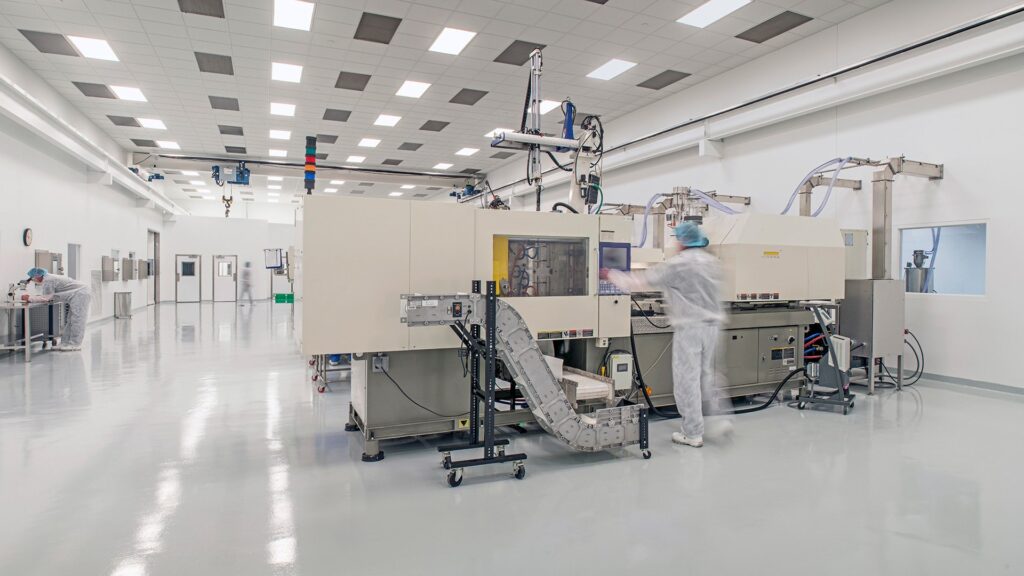
A significant portion of medical injection molding is performed inside cleanroom injection molding (ISO 14644) environments. Cleanrooms maintain low levels of airborne particulates, humidity control, HEPA-filtered airflow, and temperature stability. They are crucial for producing parts that directly contact bodily fluids, medications, or internal tissues.
ISO 14644 classifications commonly used include:
- ISO 7 and ISO 8 for syringe components and medical housings
- ISO 5 and ISO 6 for micro-molded parts and implant-adjacent devices
Automation, robotics, and sealed packaging are often integrated to keep human interaction minimal, ensuring sterility, consistency, and reduced contamination risk. These environments guarantee:
- No airborne contaminants entering the production zone
- No microbial presence on molded surfaces
- Compliance with sterilization and packaging requirements downstream
Cleanroom molding is mandatory for products such as diagnostic cartridges, IV components, surgical tips, microfluidic devices, and implantable device housings.
Medical device manufacturers often rely on prototype injection molding services to validate part performance and cleanroom process behavior before committing to full validation and FDA submission.
Regulatory Standards and Compliance
One of the defining characteristics of medical injection molding is the requirement to meet strict quality frameworks. ISO 13485-compliant molding ensures that manufacturing processes follow medical device standards for documentation, risk mitigation, corrective action, and traceability. An ISO 13485-certified manufacturer demonstrates the ability to reliably satisfy both legal and customer requirements across the full production lifecycle.
ISO 13485 specifically governs:
- Documentation control
- Risk management aligned with ISO 14971
- Process validation
- Equipment qualification
- Lot traceability
- Nonconformance handling
- CAPA (Corrective and Preventive Action) systems
- Supplier compliance
Manufacturers producing components for the U.S. market must also follow FDA-compliant medical molding under 21 CFR Part 820, the Quality System Regulation (QSR), which requires validation protocols, controlled changes, and Device History Records (DHR).
These regulatory expectations guarantee that every molded component meets healthcare safety and reliability requirements before it reaches a patient.
Process Validation: DQ, IQ, OQ, and PQ
Medical manufacturers must document and validate every stage of production through a four-part qualification process:
DQ (Design Qualification) verifies that the molding system and tooling design meet the documented design requirements before any equipment is built or purchased.
IQ (Installation Qualification) confirms that machines, molds, and auxiliary equipment are installed correctly and according to specification at the production site.
OQ (Operational Qualification) ensures the equipment operates within defined limits across the full range of expected operating conditions, not just at a single nominal setpoint.
PQ (Performance Qualification) confirms that the validated process consistently produces parts that meet specification across multiple production runs, under real production conditions.
This DQ/IQ/OQ/PQ sequence is the backbone of medical process validation. Skipping any stage, or treating it as a formality rather than a genuine verification step, is one of the most common reasons medical molding projects fail an audit or encounter quality escapes after launch.
Traceability Requirements
Beyond process validation, medical manufacturing requires full traceability across every production batch, including:
- Lot numbers and batch identification
- Material certifications tied to each lot
- Device History Records (DHR)
- Serialization for high-risk or implantable devices
These systems exist so that if a quality issue is discovered after parts have shipped, the manufacturer can trace the affected lot back to specific raw material batches, specific process parameters, and specific production dates, without needing to recall the entire production history.
Material Selection
Choosing the right polymer is essential in medical injection molding. Many medical applications require biocompatible medical plastics, which are safe for skin, tissue, and fluid contact. These materials undergo ISO 10993 or USP Class VI testing to confirm safety and resistance to chemical or biological reactions.
Common materials include:
- Polycarbonate (PC) for surgical housings and diagnostic devices, valued for clarity, impact strength, and sterilization stability
- PP and PE for syringes, IV parts, and tubing components, valued for chemical resistance and cost efficiency
- PPSU and PSU for sterilization-resistant parts that must survive repeated autoclave cycles
- TPU for flexible, soft-touch components and patient-contact surfaces
- PEEK for implant-grade and high-strength parts, particularly in orthopedic and surgical applications
Advanced polymers must be carefully dried, processed, and temperature-controlled to maintain their mechanical integrity. For a detailed breakdown of biocompatibility testing, sterilization compatibility by material, and antimicrobial additive options, see our [complete guide to medical-grade plastics selection].
Liquid Silicone Rubber (LSR) and Soft-Component Production
Many medical devices rely on soft, flexible, hypoallergenic parts, making medical injection molding an essential technology in this sector, particularly when using liquid silicone rubber (LSR). LSR is ideal for respiratory masks, wearable devices, valves, seals, baby-care components, and implant-compatible products.
It offers outstanding clarity, biocompatibility, temperature resistance, and chemical stability. LSR molding requires precision mixing and metering systems, cold-runner mold technology, and carefully controlled curing times to ensure consistent performance across production volumes.
Thin-Wall Medical Part Manufacturing
Medical devices increasingly require lightweight, compact, micro-featured parts. Thin-wall medical molding allows manufacturers to produce components with walls as thin as 0.2 to 0.4mm without compromising strength or rigidity.
This technique is widely used for:
- Diagnostic cartridges
- Microfluidic channel components
- Compact housings for wearable devices
Micro-Molding for High-Precision Medical Devices
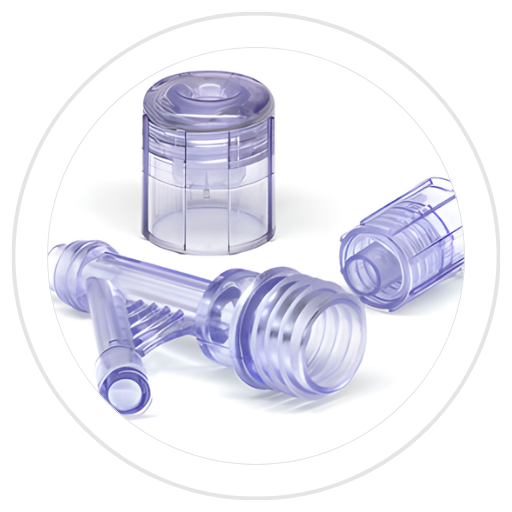
Modern healthcare devices increasingly depend on miniaturized components with ultra-fine features. Micro molding has become a fast-growing specialty within medical device injection molding, enabling the production of microfluidic channels, catheter tips, miniature gears, micro-sized valves, optical diagnostic components, and thin-walled housings with tolerances as tight as ±5 to 10 microns.
Medical micro molding supports advanced applications including in-vitro diagnostics (IVD), drug delivery systems, minimally invasive surgical tools, and wearable medical devices. Achieving this level of precision requires hardened steel tooling, high-cavitation mold layouts, and nano-level surface polishing to maintain dimensional stability across millions of cycles.
Insert Molding for Medical Devices
Insert molding allows manufacturers to combine plastic components with metal or other pre-formed parts in a single molding cycle. This is widely used in medical devices that require embedded metal contacts, reinforcement structures, or multi-material assemblies, such as surgical instrument handles with metal cores or diagnostic connectors with embedded pins.
Overmolding Medical Components
Overmolding adds a secondary material layer, typically a soft elastomer like TPE or LSR, over a rigid substrate. This is commonly used for ergonomic grips on surgical tools, soft-touch surfaces on patient-handled devices, and sealing features that require both rigidity and a soft contact surface in the same part.
Sterilization Requirements and Material Compatibility
Medical devices must endure sterilization processes without losing mechanical or aesthetic integrity. Common sterilization methods include autoclaving, gamma radiation, ethylene oxide (EtO), and electron beam sterilization, and each material responds differently.
PEEK, PC, and PP generally remain dimensionally stable across most sterilization modes. Materials like PVC or standard-grade ABS can yellow, warp, or degrade under repeated gamma radiation exposure. Selecting the correct material for the intended sterilization method, rather than assuming all medical-grade plastics behave identically, is essential to avoid in-field failures.
Why Does It Matter?
A single dimensional deviation, contamination event, or material substitution in medical injection molding can compromise patient safety and trigger costly recalls, regulatory action, and reputational damage. The combination of cleanroom production, validated processes, traceable materials, and rigorous quality systems exists specifically to prevent these outcomes, not as bureaucratic overhead, but as the foundation that makes medical devices trustworthy at scale.
Conclusion
Medical injection molding sits at the intersection of precision engineering and regulatory rigor. Success requires more than capable machinery, it requires a documented, validated, and traceable process built around cleanroom standards, qualified materials, and a quality system that can withstand audit scrutiny. Manufacturers who treat validation and documentation as core engineering disciplines, rather than paperwork exercises, are the ones capable of supporting medical device programs from prototype through full production.