If you’ve ever pulled a part with a brittle, discolored streak right at the gate, or watched one cavity in a four-cavity tool flash while the other three short,the root cause is almost always the same: the gate or runner was designed on experience alone, with no scientific molding analysis.no flow calculation, no validation.
This article picks up where gate type selection leaves off. If you haven’t settled on a gate type yet (direct, pinpoint, tunnel, cashew, ring, or film) start with our Ultimate Guide to Injection Molding Gates for the tradeoffs between them. Once you know which gate type fits your part, the question becomes purely dimensional: how deep, how wide, how long should the land be. That’s a calculation problem, not a selection problem, and it’s what this article covers.
Gate and runner geometry controls three things at once: how much shear stress the melt sees, how much pressure you lose getting material into the cavity, and how long you need to hold pressure before the gate freezes. Get any one of these wrong and you get a defect that looks unrelated to its cause: splay that looks like a moisture problem, sink that looks like a cooling problem, or short shots that look like a machine tonnage problem.
This guide walks through the four calculations we actually use to size a gate or runner: shear rate, pressure drop, freeze time, and multi-cavity balance.
What Is Gate Shear Rate (and Why It’s Different From Shear Stress).
What Shear Rate is?
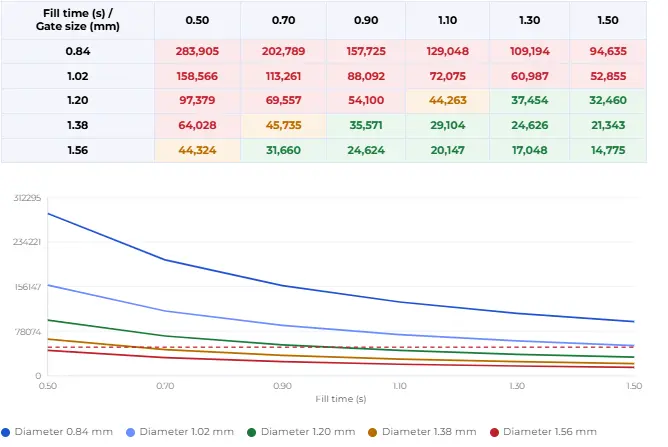
Shear rate measures how fast adjacent layers of melt slide past each other as they squeeze through a gate or runner. Polymer melts are shear-thinning: their viscosity drops as shear rate rises, which is exactly why a gate works at all. But push shear rate too high and you cross from “thinning helps flow” into “thinning means you’re tearing molecular chains apart.” That’s when you get splay, gate blush, or a part that’s brittle right at the gate even though the rest of the geometry is fine.
Round gates and runners:
γ̇ = 32Q / (πd³) = 4Q / (πr³)
Q (Volumetric Flow Rate): The volume of polymer melt passing through the gate per unit of time, typically expressed in cm3/s or mm3/s
Q=Cavity Volume/Fill Time×Number of GatesCavity Volume.
d (Diameter): The full width of the circular gate or runner channel
.
r (Radius): Half the diameter of the circular gate or runner channel
Rectangular gates:
γ̇ = 6Q / (wh²)
Where Q is volumetric flow rate (cm³/s), d and r are diameter and radius, and w and h are gate width and depth.
The detail that trips people up: in the rectangular formula, h is squared. Halve the gate depth and shear rate doesn’t double, it quadruples. This is why a gate that worked fine at 0.8 mm deep can suddenly produce splay at 0.5 mm, even though “0.3 mm thinner” sounds like a small change.
Practical limits (these vary by resin family, but as a starting reference):
If your calculated shear rate is above the material’s tolerance, the fix isn’t to lower injection speed; that just trades shear degradation for a longer fill time and a cold part. The fix is to open up the gate.
| Material type | Max recommended shear rate at gate((s⁻¹) |
|---|---|
| PES | 50,000 |
| PET | 50,000 |
| PBT | 50,000 |
| PA 12, PA 612 | 60,000 |
| PA 66 | 60,000 |
| PA 6 | 60,000 |
| HDPE | 40,000 |
| HIPS | 40,000 |
| GPS | 40,000 |
| EVA | 30,000 |
| POM | 40,000 |
| PPO | 35,000 |
| PPS | 50,000 |
| PSU | 50,000 |
| PUR | 40,000 |
| PVC | 20,000 |
| SAN | 40,000 |
| PP | 100,000 |
| PC | 40,000 |
| ABS | 50,000 |
| ABS chrome plating grades | 30,000 |
| PMMA | 40,000 |
What Shear Stress is?
Shear stress (τ) is the force per unit area acting tangentially within a polymer melt when neighboring layers of material move past each other at different speeds during flow. It is the internal resistance produced by this layer to layer sliding motion.different from normal stress, which acts perpendicular to a surface instead of along it.
Physical Origin:
During mold filling, the melt does not move as one solid block. The layer touching the mold wall stays almost still, while layers closer to the center move faster. This difference in speed across the channel creates what is called the shear rate (γ̇), and the friction produced between these sliding layers is the shear stress. This relationship is shown by the formula:
τ = η · γ̇
where η represents the apparent viscosity of the melt at that particular shear rate. Since molten plastics are pseudoplastic (meaning they become thinner under shear), η decreases as γ̇ increases. As a result, the connection between τ and γ̇ is not a simple straight line.this is one of the key features that separates polymer melts from ordinary Newtonian fluids.
For a rectangular channel which directly applies to runner and gate design shear stress at the wall can also be calculated using pressure drop instead of viscosity values:
τ = (ΔP · H) / (2L)
where ΔP is the pressure drop across flow length L, and H is the channel thickness. This formula is practical for mold design because it allows engineers to estimate shear stress directly from processing pressure and geometry, without needing detailed viscosity data.
| Aspect | Shear Stress (τ) | Shear Rate (γ̇) |
|---|---|---|
| Definition | Tangential force per unit area between sliding melt layers | Rate at which adjacent melt layers slide past each other |
| Unit | MPa (or psi) | s⁻¹ |
| Core Formula | τ = η · γ̇ | γ̇ = 4Q/πr³ (circular channel) |
| Formula (alt. channel) | τ = (ΔP · H) / (2L) | γ̇ = 6Q/wh² (rectangular channel) |
| Depends On | Viscosity and shear rate; or pressure drop, thickness, flow length | Flow rate and channel dimensions |
| Geometry Sensitivity | Indirect, through pressure drop and thickness | Direct and high,cube of diameter, square of thickness |
| Distribution in Channel | Highest at wall, lowest at center | Highest at wall, zero at center |
| Relation to Viscosity | Result of viscosity acting on shear rate | Causes viscosity to change (shear thinning) |
| Effect on Flow Behavior | Reduces apparent viscosity via disentanglement | Drives degree of shear thinning |
| Heat Generation | Excess stress converts to heat, risks degradation | Underlying cause of viscous heating |
| Molecular Orientation | Causes alignment, locks in as residual stress | Drives degree of molecular stretching |
| Resulting Defects | Gate blush, silver streaking, brittleness | Black streaking, thermal degradation, warpage |
| Typical Limits | 0.3–0.7 MPa (material-specific) | Material specific maximum values |
| Role in Process Control | Evaluates risk of degradation and residual stress | Sets injection speed and gate sizing limits |
Maximum Shear Stress Limits by Material.
| Material Type | Description | Max. Shear Stress (MPa) | Max. Shear Stress (psi) |
|---|---|---|---|
| ABS | Acrylonitrile butadiene styrene | 0.30 | 43.5 |
| PA6 | Nylon 6 | 0.50 | 72.5 |
| PA66 | Nylon 66 | 0.50 | 72.5 |
| PC | Polycarbonate | 0.50 | 72.5 |
| PET | Polyethylene terephthalate | 0.50 | 72.5 |
| PSU | Polysulphone | 0.50 | 72.5 |
| PBT | Polybutylene terephthalate | 0.40 | 58.0 |
| PMMA | Polymethyl methacrylate (acrylic) | 0.40 | 58.0 |
| SAN | Styrene acrylonitrile | 0.30 | 43.5 |
| HIPS | High impact polystyrene | 0.30 | 43.5 |
| GPPS | Polystyrene (general purpose) | 0.25 | 36.3 |
| PP | Polypropylene | 0.25 | 36.3 |
| HDPE | High density polyethylene | 0.20 | 29.0 |
| RPVC | Rigid polyvinyl chloride | 0.20 | 29.0 |
| PVC (Flex) | Flexible polyvinyl chloride | 0.15 | 21.8 |
| LDPE | Low density polyethylene | 0.10 | 14.5 |
Are Shear Rate Limits Actually Reliable? Here’s What the Research Says:
Run the numbers on a gate, get a result that’s 105% of the published maximum for your resin, and the instinct is to treat that as a verdict: redesign the gate. But before you do, it’s worth asking a question most molders never stop to ask how reliable is that published number in the first place?
The figure most of the industry still runs on – 40,000 s⁻¹ for PC, 100,000 s⁻¹ for PP, and so on, traces back to Colin Austin, during the early development of Moldflow Inc. At the time, there wasn’t a body of controlled experiments pinpointing exactly where polymer chains start tearing apart under shear, and there wasn’t much of an alternative either, so Austin’s values got folded into mold-filling software and material supplier datasheets. From there they became the collective default. Three decades on, those same numbers are still what gets quoted, less because they’ve been independently re-validated and more because everyone downstream assumed someone upstream already had.
That history alone is reason for a little skepticism. But the more useful question isn’t where the numbers came from – it’s what happens when you actually test them.
A 2003 ANTEC paper from Astor and Cleveland did exactly that. They pushed material through gates at shear rates around 950,000 s⁻¹ – roughly ten times the guideline limit for most commodity resins – and then ran mechanical and melt-flow tests on the molded parts. The result: almost no measurable change in mechanical properties. Melt flow rate crept up by about 19%, a sign that some molecular weight was lost, but nowhere near enough to call the material degraded. The working theory is that ultra-high shear mostly affects a thin layer of material right at the channel wall, leaving the bulk of the melt core essentially untouched.
That doesn’t mean the published limits are wrong, it means they’re conservative by a wide margin, which is a different thing. They were built as a safety threshold using a ratio of the material’s mechanical properties, or backed out empirically from defects analysts saw in simulation, molecular chain scission that quietly knocks down properties without leaving a visible mark, localized shear heating that shows up as black streaking or burning at the gate, or a cosmetic failure like gate blush, splay, or delamination (acetal and other semi-crystalline materials are especially prone to that last one, which is part of why their numbers tend to run conservative). None of those failure modes are predicted by shear rate alone. Even Injection Mold Design Engineering is explicit that these figures should be treated as approximate, because the real threshold depends on the polymer’s entire thermal and mechanical history – melt temperature and exposure time matter as much as the shear rate number itself.
So how reliable are shear rate limits? Reliable enough to use as a starting point and a screening check,not reliable enough to treat as a pass/fail line. If your number comes back well under the guideline, you’re almost certainly fine. If it comes back two or three times over, that’s worth investigating. But if it lands somewhere in that 100-130% gray zone, the more useful next step usually isn’t redesigning the gate. it’s checking whether your melt temperature is actually at the optimum for that grade, and how long the material is sitting in that high-shear zone. Those two variables often matter more to realworld degradation than the shear rate figure itself.
Working on a gate or runner layout that’s outside the calculator’s comfort zone? We review the geometry before you cut steel.
Talk to Our TeamConclusion:
Pull this article apart and there are really only three things worth carrying forward.
- First, shear rate and shear stress are answering two different questions. Shear rate tells you whether you’re in a reasonable range for the resin you’re running – a screening check, not a verdict. Shear stress tells you something closer to “will this part crack or warp later,” and it’s controlled by molecular orientation, not degradation risk. Conflating the two is how a perfectly fine gate gets redesigned for the wrong reason.
- Second, the “maximum shear rate” you’re checking against is a conservative guideline with a documented – and somewhat shaky – history, not a measured physical constant for your specific resin lot. That doesn’t make it useless. It makes it a starting point. A result sitting at 105-130% of the published limit is a prompt to look at melt temperature and residence time before you assume the gate itself needs to change.
- Third, the formulas in this article will get you within a reasonable range for screening, but they’re Newtonian approximations of a non-Newtonian fluid flowing through a real, three-dimensional gate geometry.not a substitute for mold-filling simulation when the part is critical, the material is shear-sensitive, or the gate sits at the edge of what the numbers say is acceptable.
Green result, comfortable margin? Move forward. You’ve done the diligence.
But if you’re sitting in that 100-130% gray zone, or running a shear sensitive resin like rigid PVC, PC,PET or a glass-filled grade where the margin for error is razor thin , don’t just rerun the spreadsheet with slightly different numbers and hope it turns green. That’s the exact moment a second set of eyes on the gate and runner layout is worth more than ten more passes through the calculator. Catching it now costs you a conversation. Catching it after steel is cut costs you a redesign.
That’s where Qlution Mold comes in. With over 15 years in injection mold manufacturing, our team has seen exactly which gate designs hold up in production and which ones look fine on paper but cause headaches at the press. Send us your part geometry and resin, and we’ll give you a straight answer redesign it, or move forward with confidence.
In that gray zone, or running a shear-sensitive resin? Send us your part geometry – 15+ years in mold manufacturing means we’ll tell you straight whether it’s a non-issue or worth redesigning before you cut steel.
Talk to Qlution Mold