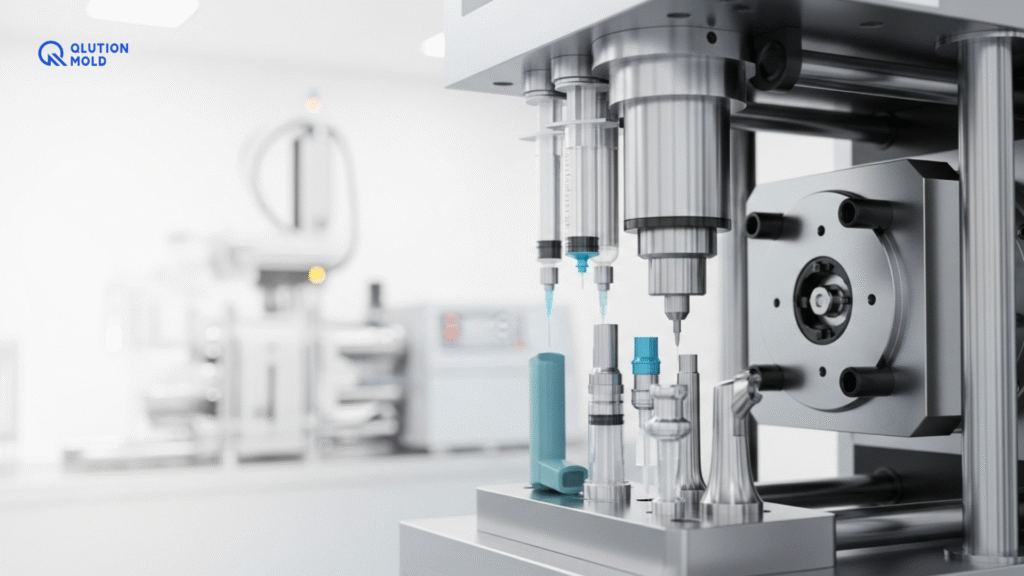
The medical device industry demands precision, biocompatibility, safety, and absolute consistency. Every component, from syringes and diagnostic cartridges to inhaler housings and surgical tools, must meet strict performance and sterility standards. This is why medical device injection molding has become one of the most important manufacturing technologies in healthcare.
Injection molding ensures high accuracy, repeatable output, cost efficiency at scale, and compatibility with FDA-approved materials, biocompatible plastics for medical use, and ISO 13485 certified molding requirements. It supports both single-use medical components and highly complex multi-material parts used in drug delivery or diagnostic systems. From micro-scale features to cleanroom production environments, injection molding provides the manufacturing reliability modern healthcare depends on.
What Is Medical Device Injection Molding?
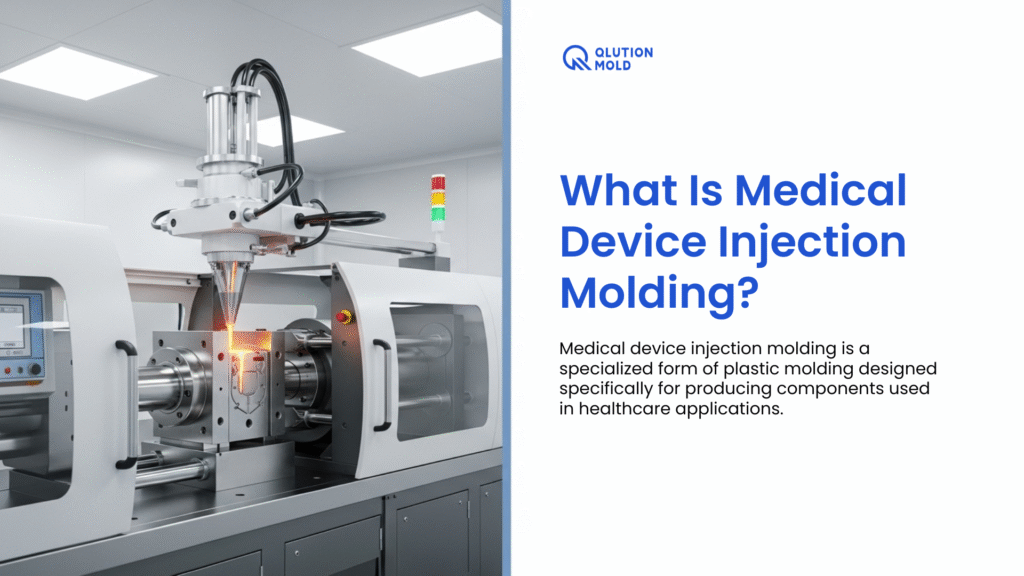
Medical device injection molding is a specialized form of plastic molding designed specifically for producing components used in healthcare applications. Unlike standard molding, medical manufacturing must adhere to stringent quality, sterility, and traceability requirements.
The process involves melting medical-grade polymer pellets, injecting them into a tightly controlled mold, and cooling them to form precise shapes. Every step is executed under strict quality protocols, often inside a sterile manufacturing environment or cleanroom injection molding facility to prevent contamination.
Cleanroom Injection Molding:
One of the biggest advantages of injection molding for healthcare is its compatibility with formal cleanroom environments. Many medical components are produced in ISO Class 7 or ISO Class 8 cleanrooms, where air filtration, particulate control, temperature, and humidity are tightly regulated.
These environments ensure:
- No airborne contaminants
- No microbial presence
- No harmful particles are entering the device
- Compliance with sterilization and packaging requirements
Cleanroom molding is mandatory for products such as diagnostic cartridges, IV components, surgical tips, microfluidic devices, and implantable device housings. By operating under a sterile environment, manufacturers guarantee the safety and purity required for patient use.
Medical-Grade Polymer Selection
Choosing the right medical-grade polymer is critical. Materials must withstand sterilization (EtO, Gamma, Autoclave), maintain dimensional stability, and meet ISO and FDA biocompatibility requirements.
Common biocompatible plastics for medical use include:
- Polycarbonate (PC): clarity, strength, impact resistance
- Polypropylene (PP): chemical resistance, cost-effective
- ABS Medical Grade: durable and moldable
- Polyethylene (PE): flexibility and toughness
- PEEK: high-performance polymer ideal for implantable-grade components
- PPSU: heat resistance for sterilization cycles
- TPU/TPE: flexible and skin-contact safe
- Acrylic (PMMA): optical clarity for diagnostic devices
Every material must pass ISO 10993 biocompatibility testing and, for US markets, must be sourced from FDA-approved materials suppliers.
Micro Molding in the Medical Industry
Modern healthcare devices increasingly depend on miniaturized components with ultra-fine features. This has made micro molding in the medical industry a fast-growing specialty within medical device injection molding.
Micro molding enables the production of microfluidic channels, catheter tips, miniature gears, micro-sized valves, optical diagnostic components, thin-walled housings, and components with ±5–10 micron tolerances. Medical micro molding supports advanced applications such as in-vitro diagnostics (IVD), drug delivery, minimally invasive surgical tools, and wearable medical devices.
Precision Molding for Healthcare Devices
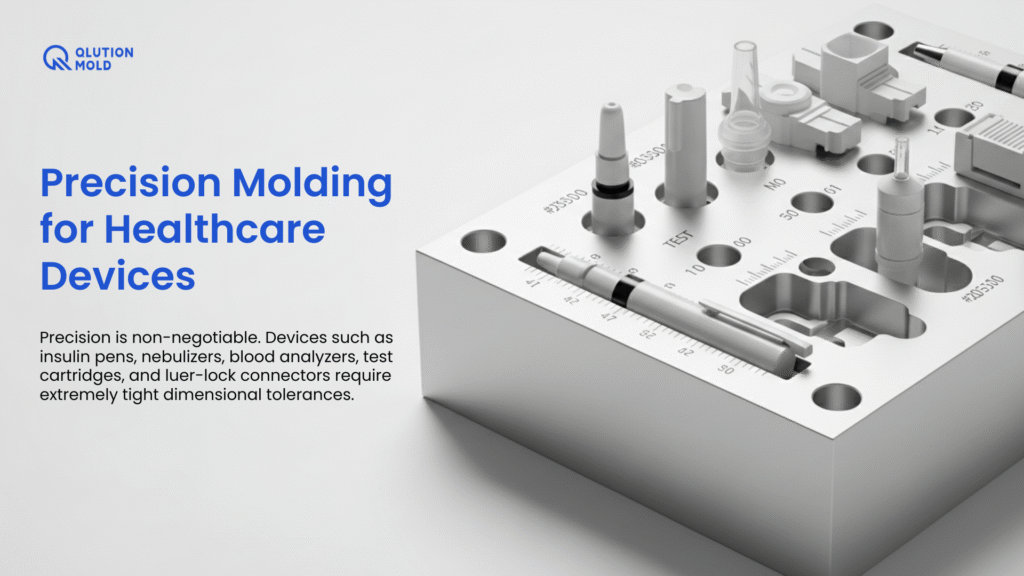
Precision is non-negotiable. Devices such as insulin pens, nebulizers, blood analyzers, test cartridges, and luer-lock connectors require extremely tight dimensional tolerances. Medical device injection molding supports complex cavity layouts, high-cavitation molds for mass volume, multi-shot molding for combining materials, insert molding for metal-plastic assemblies, and overmolding for ergonomic grips and sealing features.
This precision helps create durable, functional, and safe medical products that perform identically across millions of units.
Single-Use Medical Components: Why Injection Molding Dominates
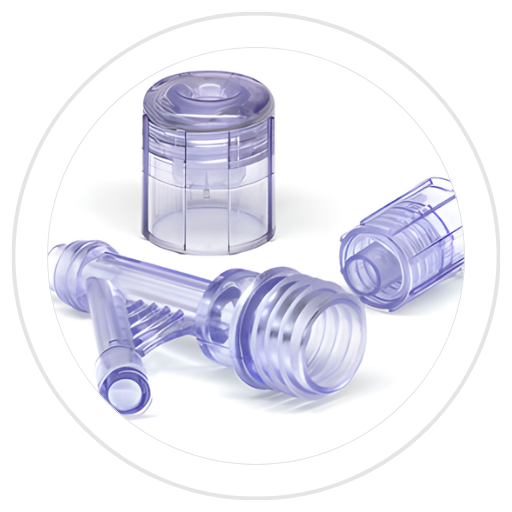
The shift toward single-use medical components is driven by infection control, cost efficiency, and global healthcare regulations. Injection molding makes mass production of disposable products both economical and consistent. Common single-use items include:
- Syringes and plungers
- IV connectors
- Diagnostic cassettes
- Catheter parts
- Surgical clips
- Medication delivery tips
- Specimen collection components
Injection molding ensures these critical supplies remain affordable, sterile, and reliable across billions of units produced annually.
ISO 13485 Certified Molding:
To supply medical-grade components, manufacturers must operate under ISO 13485 certified molding systems. ISO 13485 is the global quality standard for medical device production and governs:
- Documentation control
- Risk management (ISO 14971)
- Process validation
- Equipment qualification
- Lot traceability
- Nonconformance handling
- CAPA systems
- Supplier compliance
ISO 13485 ensures every molded part is produced under strict, repeatable, and fully audited quality controls.
Validation and Traceability Processes
Medical manufacturers must document and validate every stage of production. This involves:
DQ, IQ, OQ, PQ Validation
- DQ (Design Qualification): Verifies the molding system meets design requirements
- IQ (Installation Qualification): Confirms machines and tools are installed correctly
- OQ (Operational Qualification): Ensures machines operate within defined limits
- PQ (Performance Qualification): Confirms the process consistently produces acceptable parts
Traceability
Lot numbers, Batch identification, Material certifications, Device history records (DHR), and Serialization for high-risk devices. These systems reduce risk and maintain control over every part produced.
Sterile Manufacturing Environment and Contamination Control
Medical manufacturing must eliminate contamination completely. A sterile manufacturing environment uses HEPA filtration, Gowning procedures, Environmental monitoring, Air particle measurements, Surface sanitation protocols, Isolated molding cells, and Robotic handling to reduce human contact. This environment is essential for injectable devices, diagnostic kits, and surgical components.
Applications of Medical Device Injection Molding
Injection molding supports nearly every type of plastic-based medical device. Key applications include:
Diagnostic Devices
- IVD cartridges
- Blood analyzers
- Rapid test housings
- Optical reading chambers
Surgical and Dental Tools
- Handles
- Tips and guides
- Disposable surgical attachments
Drug Delivery Systems
- Inhaler housings
- Insulin pens
- Pump components
- Medication reservoirs
Disposable Supplies
- Syringes
- Vials
- Luer connectors
- Catheter components
Implantable Devices
- Orthopedic components
- PEEK implant structures
Equipment Enclosures
- Imaging device housings
- Monitoring equipment casings
Injecting molding’s scalability and precision make it the preferred choice across these categories.
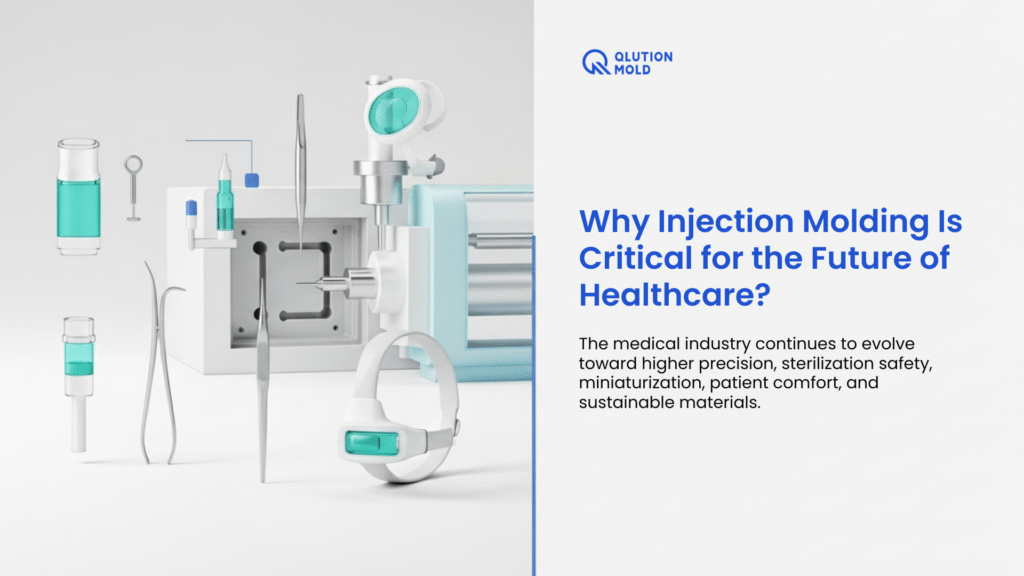
Why Injection Molding Is Critical for the Future of Healthcare?
The medical industry continues to evolve toward higher precision, sterilization safety, miniaturization, patient comfort, and sustainable materials. Medical device injection molding enables all of this with mature quality systems, high-volume cost control, micro-level precision, biocompatible material compatibility, cleanroom integration, and full manufacturing traceability. It empowers innovation in biotechnology, diagnostics, drug delivery, surgical robotics, and personalized medicine.
Conclusion:
From life-saving diagnostic tools to everyday disposables, medical device injection molding forms the backbone of modern healthcare manufacturing. It enables precision molding for healthcare devices, produces billions of single-use medical components, supports sterile cleanroom injection molding, and complies with global regulatory standards like ISO 13485 and FDA requirements.
Its ability to scale rapidly, maintain traceability, support micro molding, and work with medical-grade polymer selection ensures unmatched reliability. Injection molding isn’t just a manufacturing method; it is a critical enabler of safe, accurate, and accessible healthcare worldwide.