As product development evolves, companies face a recurring question: Injection molding vs 3D printing, which is better for production? Although both technologies create plastic parts, their strengths, workflows, and cost structures are completely different. Injection molding dominates high-volume manufacturing, while 3D printing excels in rapid prototyping, design freedom, and low-volume customization.
Understanding the differences in production speed, cost efficiency per part, material strength, scalability, surface finish, tolerances, environmental impact, and post-processing requirements is essential for choosing the right manufacturing method. This guide breaks down each process in detail and explains when to choose one over the other based on project goals.
What Is Injection Molding?
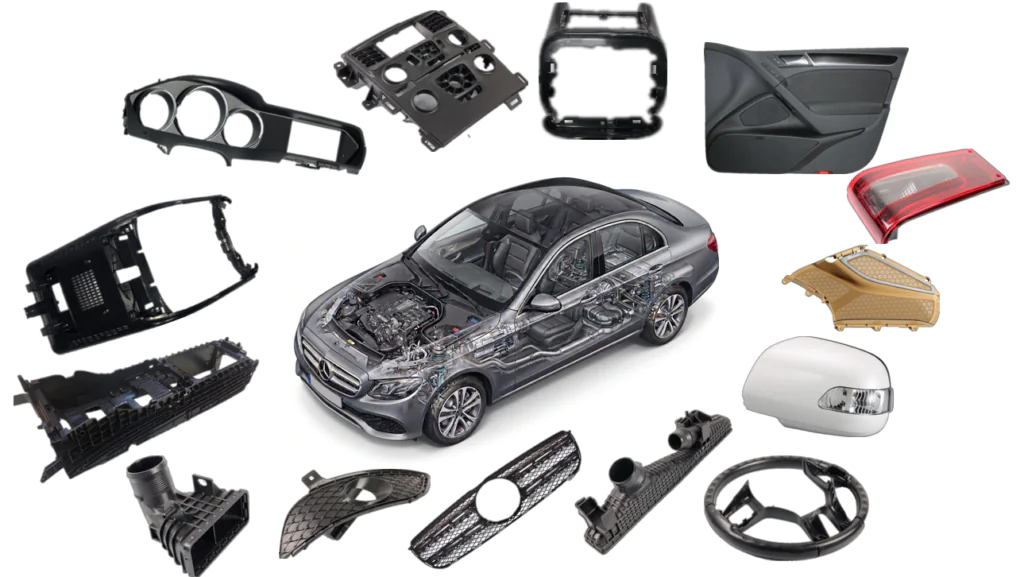
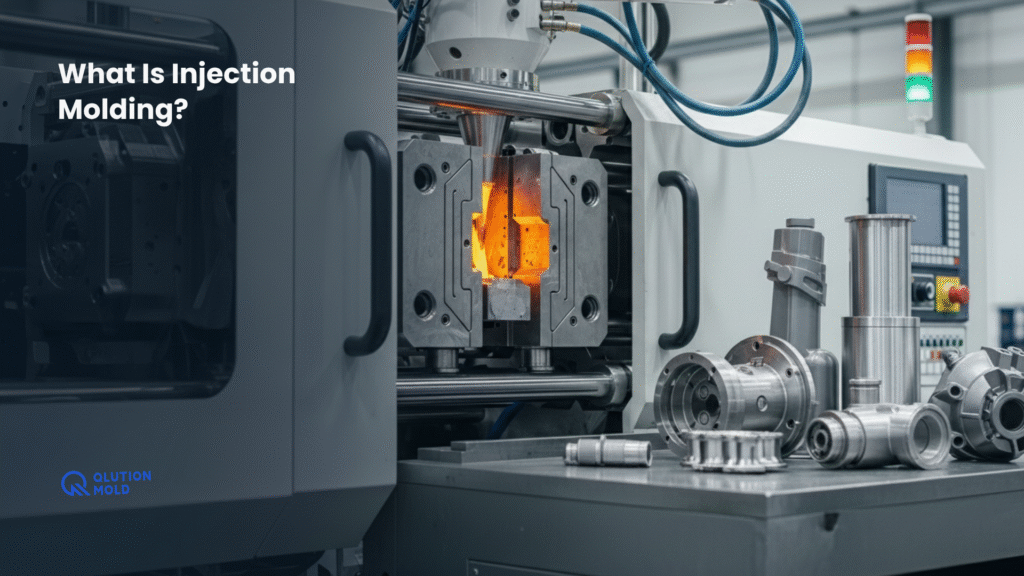
Injection molding is a manufacturing process where molten plastic is injected into a steel or aluminum mold, cooled, and ejected as a solid part. It is widely used for automotive components, consumer goods, medical devices, packaging, and industrial parts.
The process is known for high production speed, dimensional accuracy, isotropic material strength, and low cost per part at large volumes. Injection molding requires upfront tooling fabrication, but once the mold is ready, each part can be produced in seconds.
How Injection Molding Works?
Injection molding follows a precise workflow consisting of mold clamping, resin melting, high-pressure injection, cooling, and part ejection.
The mold, usually a hardened steel tool, defines the part’s geometry and surface finish. Once the plastic cools uniformly, the mold opens, ejector pins release the component, and the next cycle begins. This brings extremely fast cycle times, often 10 to 60 seconds, which is why injection molding remains unmatched for mass production scalability.
What Is 3D Printing?
3D printing (additive manufacturing) builds objects layer-by-layer using digital CAD files. Instead of injecting molten plastic into a mold, 3D printers create parts through deposition, curing, or sintering.
Common types include:
- FDM (Fused Deposition Modeling): Melts filament layer by layer
- SLA (Stereolithography): Uses UV light to cure liquid resin
- SLS (Selective Laser Sintering): Fuses nylon powder without needing support structures
- DLP (Digital Light Processing): Uses projected light for fast resin curing
3D printing is ideal for rapid prototyping, complex geometries, internal channels, organic shapes, one-off parts, and design validation. It has no tooling cost, making it attractive for low-volume production and design exploration.
When functional testing with real production materials matters, prototype injection molding delivers results that 3D printing simply cannot match.”
Production Speed Comparison
Production speed is the biggest differentiator in the injection molding vs 3d printing debate. Injection molding provides the fastest per-part cycle time, and manufacturers can produce hundreds or thousands of parts per hour once tooling is complete. However, mold fabrication can take 2–8 weeks, depending on complexity.
3D printing offers the fastest initial turnaround because it requires no tooling, but the printing process itself is slow. Parts may require hours or even days to build, especially for larger geometries or fine-detail layers. For fast prototyping, 3D printing wins. For high-volume output, injection molding remains unbeatable.
Cost Efficiency Per Part
Injection molding has a higher upfront expense due to mold fabrication, which can cost thousands to tens of thousands of dollars. However, once the mold is built, the cost per part becomes extremely low, especially beyond a few thousand units.
3D printing has no tooling cost, making it ideal for low-volume runs, prototypes, or custom one-off parts. But its per-part material cost, machine time, and post-processing make it more expensive for scaling. At small quantities (1–100 parts), 3D printing is more cost-efficient.
At medium to large quantities (1,000–1,000,000+ parts), injection molding is dramatically cheaper.
Prototyping vs Mass Production
In the injection molding vs 3d printing discussion, 3D printing is the undisputed leader for rapid prototyping. It allows instant design changes, fast iteration cycles, and complex shapes that are impossible to mold.
Injection molding is the leader for mass production, offering unmatched repeatability, durability, and unit economics. Many companies now use 3D printing for the prototype phase and injection molding for the final production run, giving them both flexibility and scalability.
Design Flexibility and Tolerances
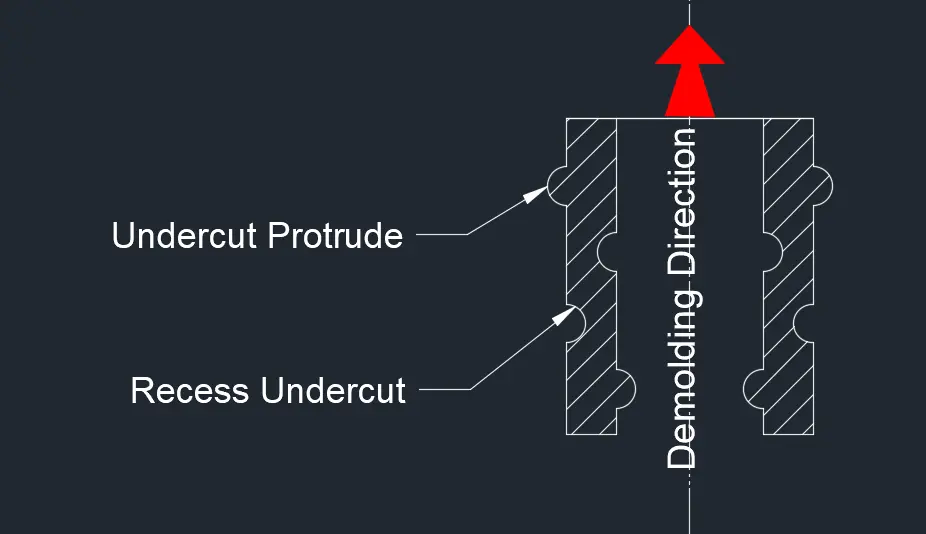
3D printing allows greater geometric complexity because it builds parts layer-by-layer. Features like internal channels, lattices, organic shapes, and complex undercuts are easy to produce without needing mold actions.
However, tolerances vary:
- FDM: Lower accuracy, noticeable layer lines
- SLA: High accuracy, smooth surfaces
- SLS: Strong functional parts, good tolerance
- DLP: Excellent resolution, crisp details
Injection molding delivers tight tolerances, stable dimensional accuracy, and excellent repeatability, especially for engineering-grade components. However, it requires draft angles, uniform walls, and mold-friendly designs, limiting some design freedom.
Material Strength Differences
In the injection molding vs 3d printing comparison, injection molded parts are isotropic, meaning they are strong in all directions due to uniform molecular bonding during cooling. This provides superior mechanical strength, impact resistance, and durability.
3D printed parts are often anisotropic, especially in FDM printing, weak between layers due to limited interlayer adhesion. While SLA and SLS offer stronger, more isotropic behavior, they still typically fall short of molded parts in load-bearing applications. For structural components, injection molding wins. For conceptual prototypes or custom shapes, 3D printing provides enough strength.
Scalability for Manufacturing
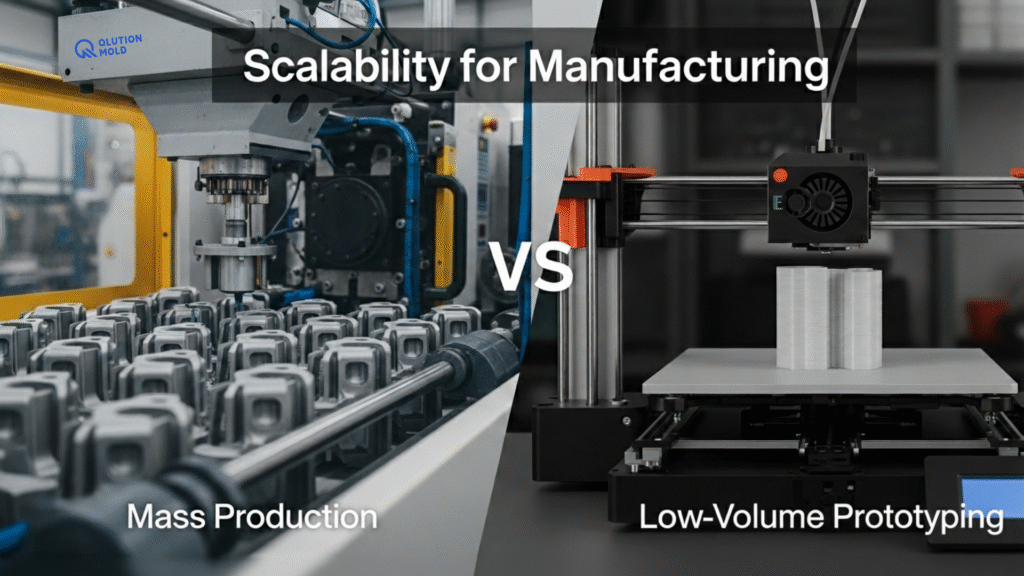
In the injection molding vs 3d printing discussion, scalability is where injection molding dominates. Once tooling exists, manufacturers can produce millions of parts with identical quality and extremely low cost per part. Automation further accelerates production speed.
3D printing does not scale linearly. Each printed part requires its own build time, and machines must run longer as volume increases. Although farms of printers can improve throughput, scaling remains far slower and more expensive than molding.
Surface Finish Comparison
Injection molding offers the best surface finish, as textures and polish levels can be integrated directly into the mold. Parts come out clean, smooth, and consistent without sanding or post-processing. 3D printing varies by technology:
- FDM: Layer lines, rough finishes
- SLA: Smooth, high-quality surfaces
- SLS: Slightly grainy matte finish
- DLP: Sharp details but requires curing
Injection molding clearly wins in surface quality for production parts.
Post-Processing Requirements
Post-processing differs significantly:
Injection Molding
- Minimal post-processing
- Occasional gate trimming
- Consistent finish out of the mold
3D Printing
- Support removal
- Sanding or polishing
- Curing (SLA/DLP)
- Powder removal (SLS)
- Painting, smoothing, or coating
These additional steps add time, labor, and cost, limiting scalability for 3D printing.
Environmental Impact Analysis
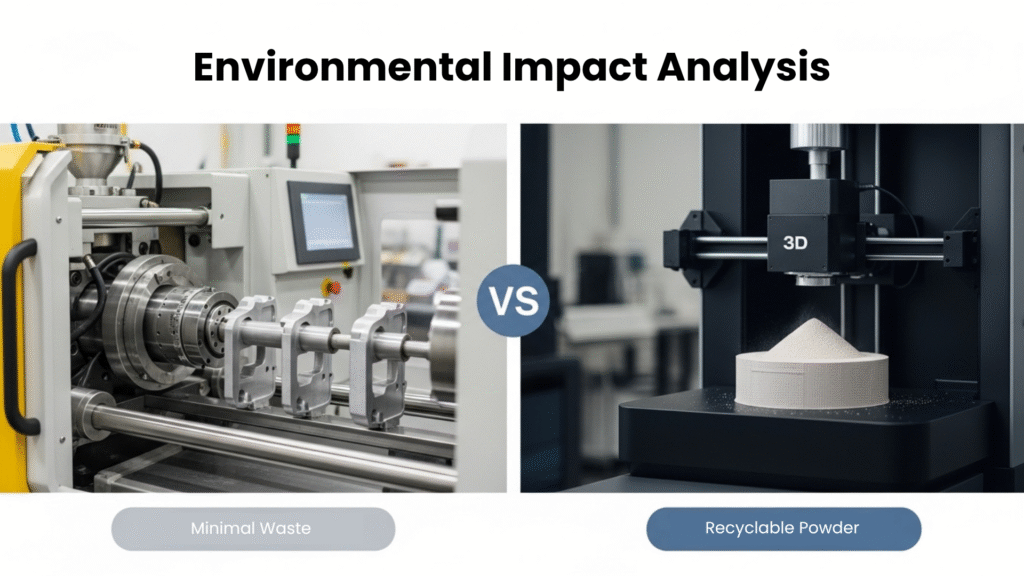
In the injection molding vs 3d printing comparison, environmental impact depends on material usage, waste, and overall energy consumption. Injection molding produces sprues and runners, which can be reground and reused. It is highly energy-efficient during large-scale production but consumes more energy during tooling fabrication.
3D printing generates minimal waste and supports recyclable powders (SLS), but certain technologies require higher energy consumption, resin disposal, and support-material waste. Both methods are evolving with greener materials, recycled polymers, and energy-efficient machines.
When to Choose Injection Molding
Choose injection molding when you need:
- High-volume production
- Consistent tolerances
- Strong mechanical performance
- Low cost per part
- Superior surface finish
- Durable engineered materials
- Long-term production scalability
When to Choose 3D Printing
Choose 3D printing when you need:
- Rapid prototyping
- Complex shapes or internal channels
- Low-volume production
- Fast design iteration
- Minimal upfront cost
- Custom or personalized part
Conclusion:
In the injection molding vs 3d printing debate, neither technology is “better” universally; each serves a distinct purpose. Injection molding is the best choice for mass production, low part cost, strength, and manufacturing scalability. 3D printing is ideal for prototyping, low-volume batches, complex designs, and rapid iteration. Many companies use both: they prototype with 3D printing and scale with injection molding, achieving faster development cycles and better long-term economics.
Understanding the differences in production speed comparison, cost efficiency per part, material strength differences, design flexibility and tolerances, surface finish comparison, environmental impact analysis, and post-processing requirements ensures you choose the right method at every stage of product development.